


Quick answer: A development-focused organization is a company where every training and coaching effort is tied directly to a business goal, assigned to a clear role, and tracked on the weekly scorecard. In a cleaning company, that means choosing development priorities from your Quarterly Drivers, defining what each role must deliver, and reviewing progress every week instead of training on whatever feels urgent.
Most cleaning company owners believe in developing their people. The trouble is that development often runs on its own track, disconnected from the goals the business is chasing. Technicians get trained on whatever came up last week, team leads get promoted without a plan, and nobody can say whether any of it moved the company forward. This guide shows how to build a development-focused organization where growth in people and growth in the business move together.
What a development-focused organization really means
A development-focused organization is not a company with the most training hours or the thickest manual. It is a company where development has a job to do. Every skill you build, every coaching conversation and every promotion is connected to something the business needs this quarter or this year.
Compare two companies with the same budget and the same number of employees. The first trains when problems show up. The second decides what the business must achieve, works out which capabilities that requires, and develops those capabilities on purpose. Both are busy. Only the second is a development-focused organization, and it is usually the one where the owner gets out of daily firefighting sooner.
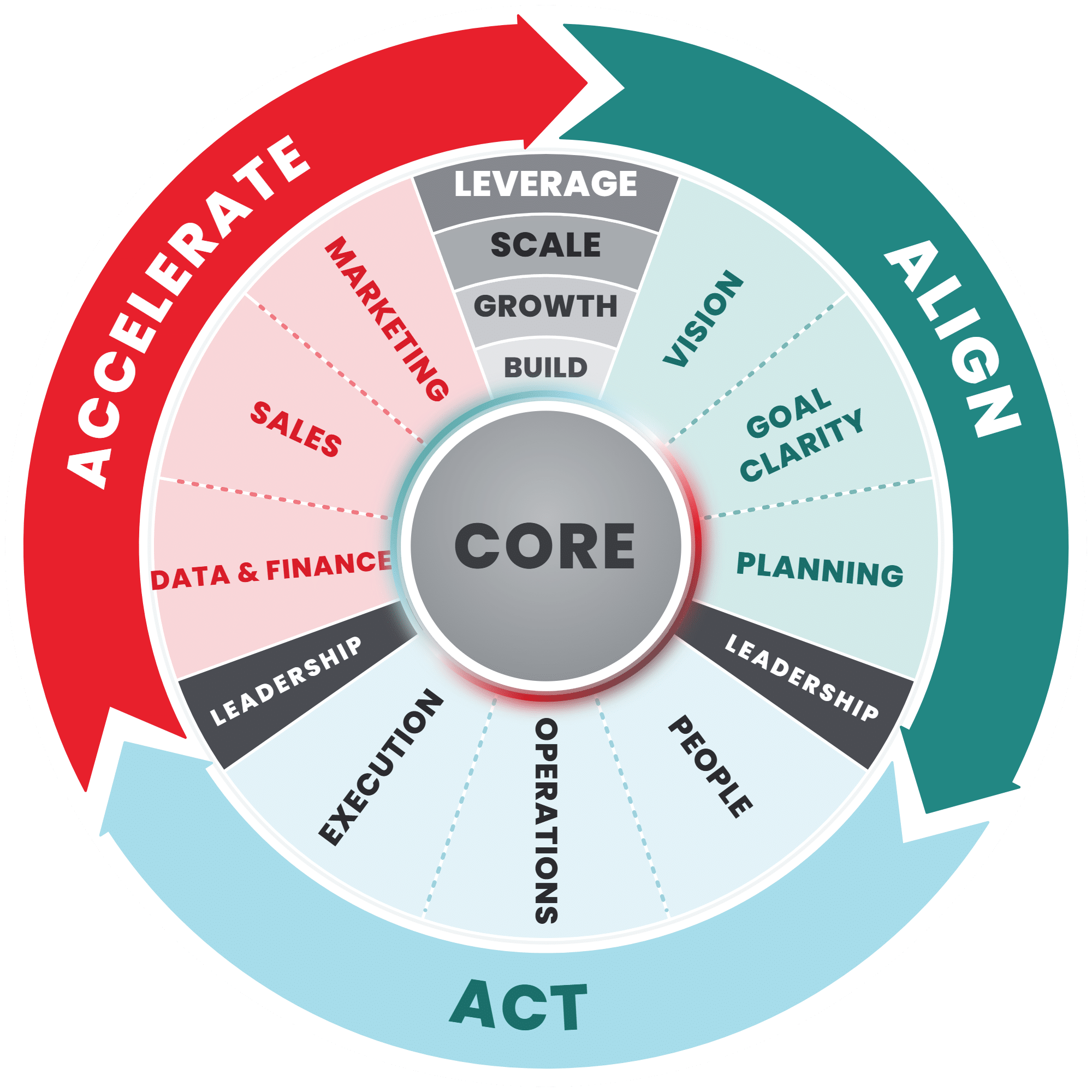
This idea fits naturally inside the Align Operating System (AOS), the operating system Core Profit Builders created for residential cleaning companies. The Align phase covers Vision, Goal Clarity and Planning. The Act phase covers People, Operations and Execution. Development is where those two phases meet: your plan tells you which people need to grow, and your people determine whether the plan gets done.
Start with the business goal, not the training topic
The most common mistake is starting with a training topic. An owner hears about a new technique or a speaker at a conference and decides the team needs it. Sometimes that is right. Often it is a distraction from what the business actually needs, and it is not how a development-focused organization chooses what to teach.
Flip the order. Begin with your annual goals and the plan for this quarter. If the goal is to add a second team lead so the owner can step back, the development priority is leadership skill. If the goal is to raise prices, the priority may be service consistency and client communication. If the goal is to grow recurring revenue, it may be sales skill for the office. A development-focused organization always asks “What does the goal require of our people?” before asking “What should we train?”
The U.S. Small Business Administration guide to writing a business plan is a good reminder that people and management belong inside the plan itself, not in a separate document that nobody revisits.
Step 1: Translate your vision into capability gaps
Write down your vision for the company three years from now and your goals for this year. Then list the capabilities the company will need to reach them. Think in terms of roles and skills, not names. For example: “two team leads who can run quality inspections without the owner” or “an office manager who can handle scheduling changes and upset clients.”
Next, compare those needs with the team you have today. The difference is your capability gap. This is where a development-focused organization gets its priorities. It is also a sobering exercise, because many owners discover that their goals assume skills nobody on the team has been asked to build.
The free AOS Diagnostic helps here. It scores your company across the nine pillars in about ten minutes. Use your scores to identify gaps, then choose priorities based on your goals and what needs to happen first.
Step 2: Connect Quarterly Drivers to development commitments
In AOS, Quarterly Drivers are the handful of priorities that move the business forward in a given quarter. If you want a refresher on setting them, read our guide to quarterly priorities for a cleaning business. In a development-focused organization, at least one Quarterly Driver usually has a people component, and every driver is checked for the skills it requires from the team.
Suppose a Quarterly Driver is “Launch a third team by the end of the quarter.” That driver depends on hiring, but it also depends on developing a team lead, training new technicians to standard, and preparing the office to schedule more homes. Each of those becomes a development commitment with an owner, a deadline and weekly actions.
A simple test for every Quarterly Driver
- Which roles must perform differently for this driver to succeed?
- What skills do those people need that they do not have yet?
- Who is responsible for building those skills, and by when?
- How will we see progress each week?
Step 3: Define roles before you develop people
You cannot develop someone toward a target you have not described. Before investing in a team lead, write down what a team lead in your company is accountable for: quality inspections, field coaching, schedule coverage, client communication, or whatever applies. Do the same for technicians, trainers and office roles. The Society for Human Resource Management offers helpful resources on job descriptions and performance expectations if you are writing these for the first time.
Each role description should include the outcomes the role owns, the numbers that show whether it is working, and the skills needed to deliver them. With clear roles, development becomes concrete. You can look at a technician and say, “To become a team lead, here are the four skills to build and how we will check them.” That clarity is the backbone of a development-focused organization.
Clear roles also prevent a quiet problem in growing cleaning companies: the best technician gets promoted and nobody explains the new job. Our article on skills development plans for technicians and team leads shows how to build those step-by-step plans once roles are defined.
Step 4: Put development on the weekly scorecard
A goal without a number is a wish. Add a few development measures to your weekly scorecard so progress is visible next to revenue, labor and quality. Good examples include training checklist completion for new hires, the number of field coaching sessions held, re-clean rate by team, and progress on a team lead’s development plan.
Keep the list short. Two or three development measures reviewed every week will do more than ten measures nobody looks at. In a development-focused organization, these numbers are owned by a specific person, and that person reports on them without being chased. GET, the Growth Execution Tool, is built for exactly this: tracking KPIs, commitments and accountability in one place.
When you are ready to judge whether development is paying off, our guide to measuring the ROI of employee development explains which metrics to compare and how often.
Step 5: Hold the rhythm in your weekly leadership meeting
Alignment fades without rhythm. The weekly leadership meeting is where a development-focused organization keeps its promises. Review the scorecard, check each development commitment, and solve the issues blocking progress.
A short agenda item is enough: “Development commitments: on track or off track?” When something is off track, the conversation is about what support the person needs, not about blame. Liz Trotter, a Certified High Performance Coach, teaches owners FTD (Feel, Think, Do) for these moments. Ask how the person feels about the commitment, what they think is getting in the way, and what they will do this week. That single habit, repeated weekly, is how a development-focused organization keeps commitments moving.

Step 6: Review and reset every quarter
At the end of each quarter, step back. Which development commitments were completed? Did they help the Quarterly Drivers they were meant to support? What capability gaps remain for next quarter and for the annual goals?
This review closes the loop. It keeps a development-focused organization honest, because development is judged by what it did for the business, not by how busy everyone felt. It also gives your people a regular moment to see their own progress, which matters for motivation and retention.
Common misalignments in a development-focused organization
Even owners who believe in this approach slip into a few predictable traps. Watch for these:
- Training on autopilot: the same onboarding every year, even when the business goals have changed.
- Promotion without preparation: great cleaners moved into leadership with no plan to build leadership skill.
- Too many priorities: five development projects at once, none finished.
- No owner: development is “everyone’s job,” so nobody tracks progress.
- Owner as the only trainer: every skill runs through one person, which caps growth. Our guide on how to stop being the bottleneck addresses this directly.
Each trap has the same fix: tie development back to a goal, a role, a number and a weekly rhythm. That is what separates a development-focused organization from a company that simply does some training.
How AOS and CPB support a development-focused organization
AOS gives owners a single system for the whole business, so development is not a separate initiative competing for attention. The People pillar sits beside Operations and Execution, and Leadership runs through every pillar. Each of the five levels builds on the last, with increasing capability across the same operating system, which you can explore on The Five Levels page.
For ongoing support, the Mastery Circle offers weekly one-hour Monday goal check-ins facilitated by Liz, access to GET, and group feedback with up to 15 owners. Owners who want one-on-one help can book private coaching with Liz. For more on the trends shaping how teams learn, read about employee development trends, and for practical programs to launch, see our list of employee development initiatives. To make learning a daily habit, explore building a culture of continuous learning.
Your first 30 days
- Week 1: Write your annual goals and current Quarterly Drivers on one page, then take the AOS Diagnostic to see your pillar scores.
- Week 2: List the capabilities each goal requires and mark the gaps. Write a short role description for technician, team lead and office roles.
- Week 3: Choose one development commitment tied to a Quarterly Driver, assign an owner, and break it into weekly actions.
- Week 4: Add two development measures to the weekly scorecard and review them in your leadership meeting so the habit of a development-focused organization begins.
Key takeaways
- A development-focused organization ties every training effort to a business goal, a role and a weekly number.
- Start with goals and Quarterly Drivers, then identify the capability gaps they reveal.
- Clear role descriptions make development concrete and fair.
- Two or three development measures on the weekly scorecard keep progress visible.
- A quarterly review keeps the development-focused organization honest about what development achieved.
Next step: Take the free AOS Diagnostic and bring your results to a conversation with our team through the contact page.
Frequently asked questions
How do I align employee development with business goals?
Start with your annual goals and Quarterly Drivers, list the capabilities each one requires, and compare them with your current team. Develop the gaps on purpose, assign each commitment to an owner, and track progress on the weekly scorecard.
What is the difference between a training program and a development-focused organization?
A training program is a set of lessons. A development-focused organization is a way of running the company where every lesson, coaching conversation and promotion supports a specific business goal and is reviewed for results.
How many development priorities should a cleaning company set each quarter?
Usually one or two. A small company with limited leadership time finishes more when it focuses on the development commitments that support its most important Quarterly Drivers.
Who owns employee development in a small cleaning company?
The owner sets direction, but in a development-focused organization each development commitment needs a named person responsible for it, such as a team lead, field trainer or office manager. Shared ownership with no name attached usually means nobody follows through.
How does a weekly scorecard support a development-focused organization?
The scorecard puts development numbers next to revenue, labor and quality, so leaders review them every week. Problems are caught early, progress is visible, and development stays connected to the results the business is chasing.
Turn these ideas into consistent action
Mastery Circle gives owners weekly goal check-ins with Liz, KPI review, group feedback and accountability.
Not sure where to focus? Take the optional AOS Diagnostic.

Founder of Core Profit Builders and creator of the Align Operating System (AOS). Part owner in six cleaning companies. Certified High-Performance Coach (CHPC) and co-host of the Smart Business Moves podcast.
More about Liz