


Quick answer: Every cleaning company owner needs seven core skills to build a business that runs without constant firefighting: pricing for profit, hiring and keeping good people, building systems and delegating, selling with confidence, reading the numbers, managing time and priorities, and leading with a healthy mindset.
Nobody hands a new cleaning company owner a manual. Most owners learn by doing, which works until the business grows past what one person can hold in their head. At that point, the skills that got you started are not the skills that will get you to the next stage. The good news is that every one of these skills can be learned, and the right coaching shortens the learning curve considerably. This guide walks through each skill, what it looks like when it is working, and how expert coaching helps you build it faster than trial and error.
Why skills matter more than hustle for a cleaning company owner
Hard work is the price of admission in this business, but it is not a growth strategy. A cleaning company owner who works 70 hours a week with weak pricing and no systems will usually earn less than an owner who works 40 hours with strong ones. The difference is skill, not effort.
Core Profit Builders (CPB) built the Align Operating System (AOS) around this idea. AOS organizes a residential cleaning company into three phases: Align (Vision, Goal Clarity, Planning), Act (People, Operations, Execution) and Accelerate (Data & Finance, Sales, Marketing), with Leadership running through every pillar. The seven skills below map directly onto those pillars, which is why coaching inside a system tends to stick better than random tips.
The 7 core skills every cleaning company owner must master
Here are the seven skills, in no particular order. Most owners are strong in two or three and need real work on the rest. That is normal, and it is true for almost every cleaning company owner we meet.
1. Pricing for profit
Pricing is the skill with the fastest impact on the bottom line. Many owners set prices by looking at competitors, then discount whenever a prospect hesitates. The result is a full schedule and an empty bank account, a pattern almost every cleaning company owner recognizes. A skilled cleaning company owner prices from their own costs: labor, supplies, drive time, overhead and the profit margin they need to stay healthy.
What good looks like: you know your labor percentage, you raise prices on a schedule instead of in a panic, and you can explain your price without apologizing. Our guide on how to price cleaning services for profit covers the math.
How coaching helps: a coach reviews your actual numbers with you, spots the jobs that lose money, and gives you language for price increases so clients hear value instead of a surprise.
2. Hiring and keeping good people
In residential cleaning, your team is your product. Every cleaning company owner eventually learns that a hiring problem is really a growth ceiling. If you cannot staff the schedule, you cannot add clients, no matter how strong your marketing looks on paper.
What good looks like: a steady hiring process instead of emergency ads, a clear onboarding plan, and team members who understand how their work connects to the company's goals. Our article on reducing turnover in a cleaning company goes deeper, and the Society for Human Resource Management is a solid general resource on people practices.
How coaching helps: Liz Trotter, CPB's founder, is a Certified High Performance Coach with extensive DISC training and coaches Employee Engagement at MaidCentral Academy. Coaching helps you hire for fit, have better conversations using frameworks like FTD (Feel, Think, Do), and build a culture where good cleaners want to stay for years.
3. Building systems and delegating
If every answer lives in your head, you are the bottleneck. The third skill is translating what you know into written processes that others can follow, then actually letting go. This is where many owners struggle, because for a cleaning company owner who started as a cleaner, delegating feels slower than doing it yourself, at least at first.
What good looks like: documented processes for cleaning, scheduling, quality checks and client communication, and team leaders who make decisions without calling you. See our guide to cleaning SOPs and the article on how to stop being the bottleneck.
How coaching helps: a coach holds you to the handoff. A cleaning company owner who commits in a group to delegating one process this week is far more likely to follow through than one who simply intends to get around to it someday.
4. Selling with confidence
Many owners never had sales training, and it shows in how they handle the phone. They answer questions, give a price, and hope. A confident cleaning company owner treats sales as a helpful conversation: understanding what the client needs, explaining the value of the service, and asking for the booking.
What good looks like for a cleaning company owner: a consistent process for inquiries, quotes that are followed up, and an office team that can sell as well as the cleaning company owner does.
How coaching helps: CPB's Sales Circle is weekly live group sales coaching for owners and their salespeople. Practicing real calls with feedback builds skill much faster than reading sales books alone. Membership is $2,495 per year or $255 per month, with additional participants from the same company at $95 per month each.
5. Reading the numbers
You do not need to be an accountant, but you do need to understand what your numbers are telling you. A cleaning company owner who checks a handful of key metrics every week can spot problems early, while there is still time to fix them.
What good looks like: a weekly scorecard with five to ten numbers, such as revenue, labor percentage, client retention, new leads and closing rate, reviewed in a regular leadership meeting. Our guide to cleaning business KPIs and the weekly scorecard shows how to set up your first version.
How coaching helps: CPB uses GET, the Growth Execution Tool, to track KPIs, commitments and accountability. When your numbers are visible to a coach and peers, it becomes much harder to avoid the uncomfortable ones.
6. Managing time and priorities
Most owners do not lack time; they lack a filter. A busy cleaning company owner can fill any week with urgent work. Without clear priorities, every urgent text wins over every important project. The sixth skill is choosing what matters most this quarter and protecting the time those priorities need.
What good looks like: a vision, annual goals, a short list of Quarterly Drivers, and weekly actions that move those drivers forward. Our article on quarterly priorities for a cleaning business explains the method.
How coaching helps: in CPB's Mastery Circle, owners meet with Liz every Monday for a one-hour goal check-in. That weekly rhythm keeps a cleaning company owner focused on the few things that matter instead of the hundred things that are loud.
7. Leading with a healthy mindset
The final skill sits underneath all the others, and it is the one a cleaning company owner most often overlooks. An owner who is exhausted, anxious or stuck in old habits will struggle to apply any system well. Leadership is not a title; it is how you show up for your team, your clients and yourself.
What good looks like: calm responses to problems, clear expectations, and the ability to step back and think strategically. Liz's GOOYOW framework (Get Out Of Your Own Way) helps owners notice the beliefs that keep them doing work others should own. Her TIDY framework (Thank you, I'm sorry, Don't worry, You're right) gives a simple script for upset clients.
How coaching helps: an outside coach can see patterns you cannot see from inside the business, and a peer group reminds you that every cleaning company owner faces the same doubts at some stage.
How expert coaching helps a cleaning company owner build skills fast
A cleaning company owner can learn all seven skills alone. Many do, slowly and expensively. Coaching speeds things up in three practical ways.
- Diagnosis: the free AOS Diagnostic asks 18 questions in about ten minutes and returns an AOS Score from 0 to 100, your current level and a score for each pillar. Use your scores to identify gaps, then choose priorities based on your goals and what needs to happen first.
- Structure: AOS gives every skill a place to live, so improvements build on each other instead of competing for attention.
- Accountability: weekly check-ins, hot seats and peer feedback make it hard to drift back into old habits.
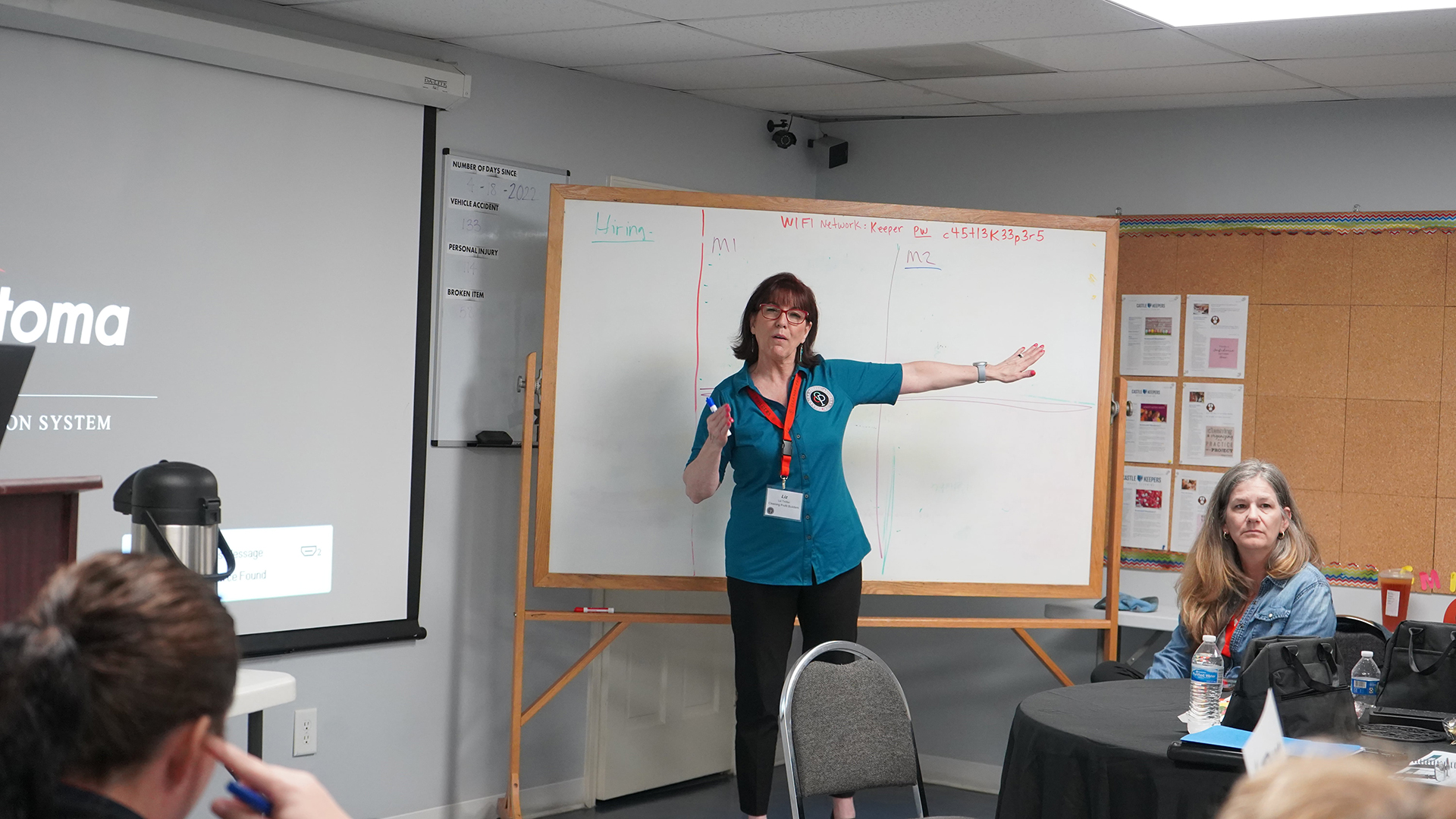
CPB offers several kinds of support. Mastery Circle includes weekly Monday goal check-ins facilitated by Liz, GET access, group feedback and hot seats through ALIGN, ACT and ACCELERATE, in groups of up to 15 owners across all five AOS levels. It is $4,995 paid annually, or a $1,000 initial payment followed by 11 monthly payments of $449. Private coaching with Liz is available in one, three, six or twelve hour packages starting at $350, with lower rates for members. CPB also runs live events throughout the year.
Liz brings her own experience as a cleaning company owner to every session. She has been a part owner in six cleaning companies. She also co-hosts the Smart Business Moves podcast with Tom Stewart of MaidCentral, which is a good free way to hear how she thinks about running a residential cleaning company.
Coaching is not the only resource. SCORE offers free small-business mentoring, and ISSA provides cleaning industry education. If you are weighing the cost, our article on whether cleaning business coaching is worth it lays out the tradeoffs honestly.
Which skill should a cleaning company owner work on first?
It depends on your goals and where the business is today. No two companies are the same, so no cleaning company owner should copy another owner's plan without adapting it. An owner with a full schedule and thin margins usually needs pricing and numbers first. An owner who cannot take a day off usually needs systems and delegation. An owner with plenty of leads and few bookings usually needs sales.
The fastest way to know is to measure. Take the diagnostic, look at your pillar scores alongside your goals, and pick one or two skills to focus on for the next quarter. Trying to fix all seven at once is a reliable way to fix none of them.
Your first 30 days
- Week 1: Take the free AOS Diagnostic and rate yourself from 1 to 10 on each of the seven skills. Note where your scores and your self‑ratings disagree.
- Week 2: Pick one or two skills that matter most for your goals this quarter. Write one measurable outcome for each.
- Week 3: Take one concrete action on each skill, such as reviewing prices on your ten least profitable clients or documenting one process you still do yourself.
- Week 4: Review what changed, set up a simple weekly scorecard, and decide whether you want the accountability of Mastery Circle, Sales Circle or private coaching.
Key takeaways
- Every cleaning company owner needs seven core skills: pricing, hiring, systems and delegation, sales, numbers, time and priorities, and leadership mindset.
- Skills, not hours, are what separate a business that grows from one that burns the owner out.
- Each skill maps onto a pillar in the Align Operating System, so progress in one area supports the others.
- Coaching speeds up skill building through diagnosis, structure and weekly accountability.
- Focus on one or two skills per quarter, chosen from your diagnostic scores and your goals.
Next step: Take the free AOS Diagnostic to see where your skills stand, or visit Start Here to explore your coaching options.
Frequently asked questions
What skills does a cleaning company owner need most?
The seven core skills are pricing for profit, hiring and keeping good people, building systems and delegating, selling with confidence, reading the numbers, managing time and priorities, and leading with a healthy mindset.
Can I learn these skills without a coach?
Yes. Many owners learn them through experience, books and free resources such as SCORE. Coaching shortens the process by adding a clear framework, outside perspective and weekly accountability so new habits stick.
How does Core Profit Builders teach these skills?
Core Profit Builders uses the Align Operating System along with Mastery Circle weekly goal check-ins, Sales Circle group sales coaching, private coaching with Liz Trotter, and live events. GET, the Growth Execution Tool, tracks KPIs, commitments and accountability.
Which skill should I focus on first?
Use your AOS Diagnostic scores to identify gaps, then choose priorities based on your goals and what needs to happen first. Most owners make better progress by focusing on one or two skills per quarter.
Is Sales Circle only for the cleaning company owner?
No. Sales Circle is weekly live group sales coaching for owners and their salespeople. It costs $2,495 per year or $255 per month, and additional participants from the same company can join for $95 per month each.
Turn these ideas into consistent action
Mastery Circle gives owners weekly goal check-ins with Liz, KPI review, group feedback and accountability.
Not sure where to focus? Take the optional AOS Diagnostic.

Founder of Core Profit Builders and creator of the Align Operating System (AOS). Part owner in six cleaning companies. Certified High-Performance Coach (CHPC) and co-host of the Smart Business Moves podcast.
More about Liz