

Quick answer: The essential leadership skills for cleaning business owners are setting a clear direction, communicating expectations, coaching people well, delegating with trust, holding the team accountable, handling conflict calmly, making decisions with data, and managing your own mindset so you lead the business instead of reacting to every problem.
Most cleaning business owners never planned to become leaders. They planned to clean homes well, serve clients and earn a good living. Then the company grew, people were hired, and suddenly the job changed. The owner is no longer the best cleaner on the team; they are the person everyone looks to for direction, decisions and support. That shift requires a different set of abilities, and the good news is that leadership skills can be learned like any other business skill.
How do I get leadership buy-in for cleaning software?
Start with the business problem, then agree on a small test. For a residential cleaning company, software adoption is a leadership decision about responsibilities, training and follow-through as well as a product choice.
- Define one problem and a baseline. For example, record how often schedule changes require repeated office-to-field calls before testing a new scheduling workflow.
- Involve the people who own the work. Ask the owner, office manager and a field lead what a successful handoff looks like. Let them identify practical obstacles before selecting a tool.
- Make the pilot clear. Write down the workflow, the person responsible, training time, costs and the review date. Ask the software provider to confirm product capabilities, support and any setup or migration requirements.
- Review results together. Test one workflow with a small group. Compare missed handoffs, time spent and service issues with the baseline. Use those results to decide whether to expand, adjust or stop; logins alone do not show that a process works.
A useful one-page decision brief says: “Here is the problem, here is what we will test, here is who owns it, and here is how we will judge it.” Invite concerns about workload and training, and give each concern an owner and a next step.
If leadership follow-through is the sticking point, explore Mastery implementation coaching. For an office manager developing leadership habits, review Manager Circles. Ask CPB which support fits your team; ask the software provider about product‑specific setup.
Why leadership skills matter more as your cleaning business grows
In a very small company, the owner can lead by example. Everyone sees what good work looks like because they work beside the owner every day. As the team grows and crews spread across town, that stops working. People need clear expectations, regular feedback and someone who can see the bigger picture.
Weak leadership skills show up in familiar ways: high turnover, inconsistent quality, an office that waits for the owner to make every call, and a team that hears about goals once a year, if ever. Strong leadership skills show up as a calm, consistent business where people know what is expected and feel supported in doing it. Our article on reducing turnover in a cleaning company explores how closely retention and leadership are linked.
Leadership also affects clients directly. Residential cleaning is a trust business: clients let your team into their homes, often when nobody is there. Cleaners who feel respected, trained and supported tend to take more care, communicate better and stay longer, and clients notice that consistency. In other words, the way an owner leads inside the company shapes the experience clients have outside it, every single visit.
8 essential leadership skills for cleaning business owners
These eight leadership skills build on each other. You do not need to master all of them at once, but each one makes the others easier.
1. Setting a clear direction
People follow direction, not intentions. The first leadership skill is defining where the company is going and explaining it in a way your team understands. That means a written vision, a few annual goals, and quarterly priorities that connect daily work to the bigger picture.
When the team knows the direction, they make better decisions without you. Our guide to quarterly priorities for a cleaning business shows how to set them.
2. Communicating expectations clearly
Most performance problems start as communication problems. If a cleaner does not know exactly what “clean” means in a client’s kitchen, quality will vary. Clear expectations live in written standards, checklists and training, not only in the owner’s memory.
Communication also means adapting to different people. Liz Trotter, founder of Core Profit Builders (CPB), has extensive DISC training, and understanding personality styles helps owners communicate in ways each team member actually hears.
3. Coaching team members
Telling people what to do is managing. Helping them get better is leading. Coaching conversations are among the most valuable leadership skills an owner can build, because they grow the team instead of just correcting mistakes.
Liz teaches a simple framework called FTD: Feel, Think, Do. It gives structure to coaching conversations so feedback leads to real change instead of defensiveness.
4. Delegating with trust
Many owners say they delegate, but what they really do is assign tasks and then check every detail. True delegation means handing off ownership of an outcome, with clear standards, and letting the other person do the work.
Documented processes make this possible. Our guide to cleaning SOPs explains how to write them, and how to stop being the bottleneck covers the mindset side of letting go of control.

5. Holding people accountable
Accountability is not punishment. It is the habit of making clear commitments and checking on them consistently. Without it, even good plans fade.
A weekly leadership meeting and scorecard give accountability a home. Each person reports on their numbers and their commitments, problems get solved, and nothing waits a month to surface. Our article on the weekly leadership meeting for a cleaning business includes a practical agenda. CPB also uses GET, the Growth Execution Tool, to track KPIs, commitments and accountability.
6. Handling conflict and upset clients
Every cleaning business deals with conflict: a client unhappy with a clean, two team members who do not get along, a schedule change nobody likes. Leaders who stay calm and respond with a plan earn trust quickly.
For upset clients, Liz teaches TIDY: Thank you, I’m sorry, Don’t worry, You’re right. It is a simple script that lowers tension and protects the relationship while you solve the problem. Teaching it to your office team spreads these leadership skills beyond the owner.
7. Making decisions with data
Gut instinct has its place, but leaders who rely only on feelings tend to react to the loudest problem. Leaders who track a few key numbers each week see trends early and decide with confidence.
You do not need a complex dashboard. Five to ten numbers, such as revenue, labor percentage, client retention, leads and closing rate, are enough to start. See our guide to cleaning business KPIs and the weekly scorecard.
8. Managing yourself
The last of these leadership skills is the hardest: leading yourself. An owner who is exhausted, overcommitted or stuck in old habits will struggle to lead anyone else well. Liz’s GOOYOW framework, Get Out Of Your Own Way, helps owners notice the beliefs and habits that keep them doing work others should be trusted to handle.
Managing yourself also means protecting time to think. Leaders who never step away from daily operations rarely have the energy to plan, coach or improve the business.
Signs your leadership skills need attention
Leadership gaps are easy to miss from the inside, because owners are usually too busy to notice patterns. A few honest questions can reveal where your leadership skills need the most work.
- Do team members bring you problems they could solve themselves?
- Do the same quality issues keep coming back after you address them?
- Do you avoid difficult conversations until a situation becomes a crisis?
- Could your team explain this quarter’s priorities without checking with you?
- Do you finish most weeks feeling reactive instead of in control?
If several of these sound familiar, you are in good company. Almost every owner of a growing cleaning business reaches this point, because the leadership skills that worked for a team of four rarely work for a team of twenty. The answer is not to work harder; it is to lead differently. Pick the one or two skills from the list above that would make the biggest difference for your goals, and focus there for the next quarter.
It also helps to ask for feedback. Team leaders and office staff often see leadership gaps before the owner does. A simple question such as “What is one thing I could do to make your job easier?” often produces surprisingly useful answers, and asking it regularly builds trust.
How leadership skills fit into the Align Operating System
CPB created the Align Operating System (AOS) for residential cleaning companies. AOS organizes the business into three phases: Align (Vision, Goal Clarity, Planning), Act (People, Operations, Execution) and Accelerate (Data & Finance, Sales, Marketing).
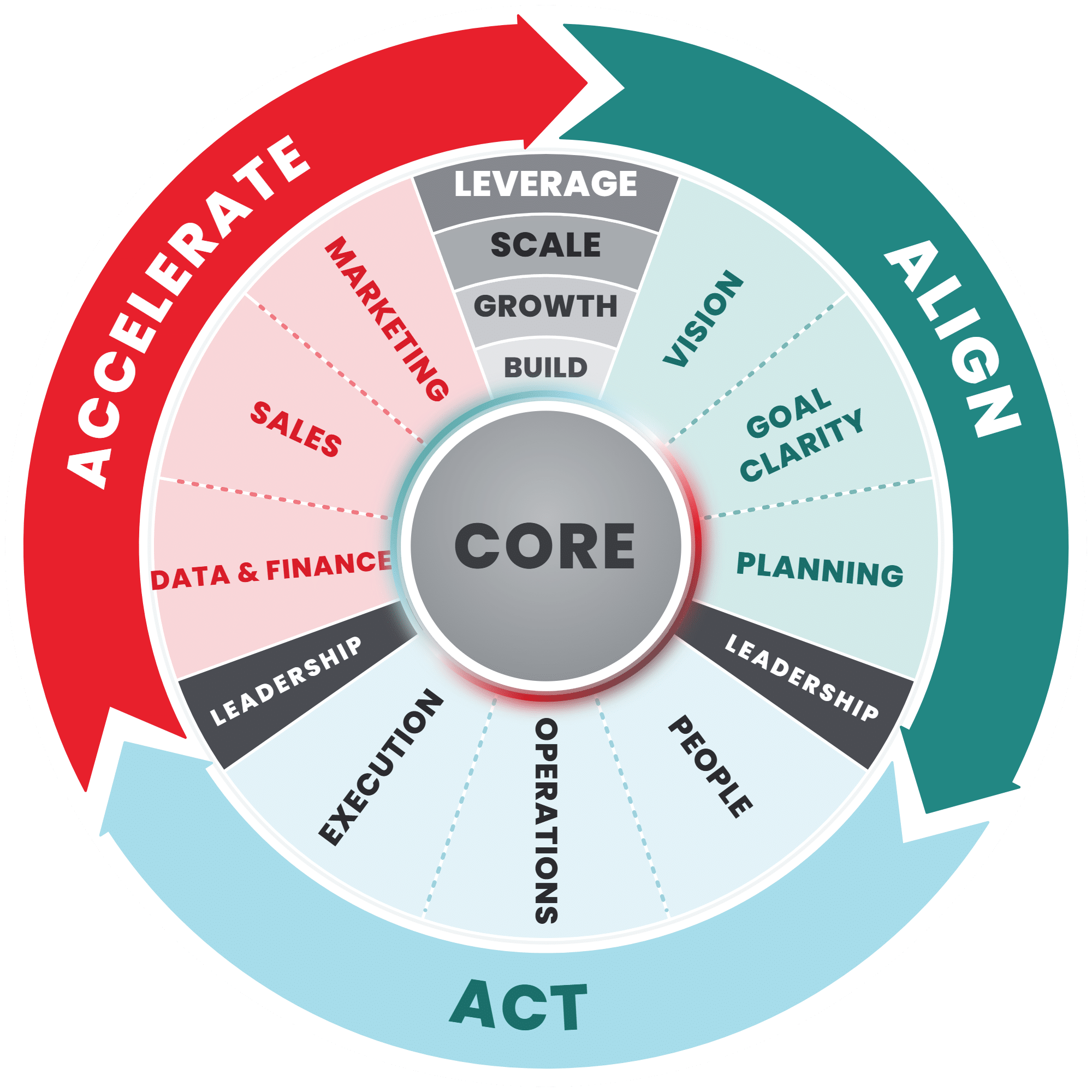
Leadership is not a separate box in AOS. It runs through every pillar. That reflects reality: pricing decisions, hiring choices, marketing plans and financial reviews all depend on how well the owner leads. Improving your leadership skills tends to lift the whole wheel, not just one section of it. You can see each pillar on the AOS pillars page.
AOS also has five levels: Core, Build, Growth, Scale and Leverage. Each level builds on the last, with increasing capability across the same operating system. The leadership skills described here matter at every level, though how you apply them grows with the company. An owner leading a small team leans heavily on personal coaching and clear standards, while an owner leading through managers leans more on accountability systems, data and developing other leaders.
Developing leadership skills in your team leaders
An owner cannot be the only leader for long. As the company grows, team leaders, office managers and operations managers need leadership skills too. Building those skills in others is one of the highest-value investments an owner can make.
- Model the behavior. Your team leaders will lead the way you lead. Calm, clear and consistent leadership is contagious.
- Teach the frameworks. Share FTD for coaching conversations and TIDY for upset clients so everyone uses the same language.
- Give real ownership. Let team leaders own a number on the scorecard and report on it every week.
- Include them in planning. Leaders who help set Quarterly Drivers care more about reaching them.
For people-related practices like hiring, reviews and policies, the Society for Human Resource Management is a reliable general resource.
How coaching builds leadership skills faster
Leadership is hard to learn from a book because it happens in real moments: a tough conversation, a missed commitment, a tense client call. Coaching helps because it works on those real moments as they happen. Instead of studying leadership skills in theory, you bring a real situation, talk it through, commit to an action, and report back the following week.
CPB’s Mastery Circle brings owners together every Monday for a one-hour goal check-in facilitated by Liz, with GET access and group feedback and hot seats through ALIGN, ACT and ACCELERATE. Groups are capped at 15 owners. For individual help, private coaching with Liz focuses on your specific leadership challenges. CPB also runs live events where owners learn alongside peers.
Liz brings decades of practical experience. She has been a part owner in six cleaning companies, is a Certified High Performance Coach, and coaches Employee Engagement at MaidCentral Academy. She also co-hosts the Smart Business Moves podcast with Tom Stewart of MaidCentral. For broader small-business guidance, SCORE offers free mentoring.
Your first 30 days
- Week 1: Take the free AOS Diagnostic and rate yourself from 1 to 10 on each of the eight leadership skills. Ask one trusted team member to rate you too.
- Week 2: Write or update your vision and share it with your team. Explain the top three priorities for this quarter in plain language.
- Week 3: Start a weekly leadership meeting with a simple scorecard. Practice one FTD coaching conversation with a team leader.
- Week 4: Delegate one process you still own, with written standards. Teach TIDY to your office team and review what changed this month.
Key takeaways
- Leadership skills become more important as a cleaning business grows beyond what the owner can see directly.
- The eight essential skills are direction, communication, coaching, delegation, accountability, conflict handling, data-driven decisions and self‑management.
- Liz Trotter’s frameworks, FTD, TIDY and GOOYOW, give owners simple tools for real leadership moments.
- In the Align Operating System, Leadership runs through every pillar, so better leadership lifts the whole business.
- Developing leadership skills in team leaders multiplies the owner’s impact.
Next step: Take the free AOS Diagnostic to see your scores, or visit Start Here to find the right support for your next step.
Frequently asked questions
What are the most important leadership skills for cleaning business owners?
The most important leadership skills are setting a clear direction, communicating expectations, coaching team members, delegating with trust, holding people accountable, handling conflict, making decisions with data and managing yourself.
Can leadership skills be learned?
Yes. Leadership is a set of habits and skills, not a personality trait. Owners build it through practice, feedback and simple frameworks such as FTD for coaching conversations and TIDY for upset clients.
How do I develop leaders on my team?
Model the behavior you want, teach shared frameworks, give team leaders real ownership of a number on the scorecard, and include them in setting quarterly priorities.
How does Core Profit Builders help owners lead better?
Core Profit Builders offers Mastery Circle weekly goal check-ins with Liz Trotter, private coaching, and live events, all built on the Align Operating System, where Leadership runs through every pillar.
Where should I start?
Start with the free AOS Diagnostic. It takes about ten minutes, asks 18 questions, and gives you an AOS Score from 0 to 100, your current level and a score for each pillar.
Develop the people leading your team
Learn Circle supports supervisors and managers with people and daily operations, Build Circle adds KPI management, and Leadership Circle develops senior leaders.
Not sure where to focus? Take the optional AOS Diagnostic.

Founder of Core Profit Builders and creator of the Align Operating System (AOS). Part owner in six cleaning companies. Certified High-Performance Coach (CHPC) and co-host of the Smart Business Moves podcast.
More about Liz