

Quick answer: Strategic goal setting for a cleaning company means connecting a clear long-term vision to a few annual goals, breaking those goals into Quarterly Drivers, and then into weekly actions that specific people own, so the whole team works on what matters most instead of whatever feels urgent today.
Most owners of residential cleaning companies have goals. Fewer practice strategic goal setting, so they have no real strategy for reaching them. The difference shows up every January, when big intentions meet a schedule full of callouts, client requests and hiring gaps. By spring, the goals are forgotten and the year is running the owner instead of the other way around. Strategic goal setting fixes that by giving every goal a path from the big picture down to this week's to‑do list.
What strategic goal setting means for a cleaning company
Ordinary goal setting stops at the goal: "grow revenue," "hire more cleaners," "take a vacation." Strategic goal setting goes further. It asks why the goal matters, how it connects to the long-term direction of the company, what has to happen first, and who owns each piece. Strategic goal setting is a planning discipline, not a wish list.
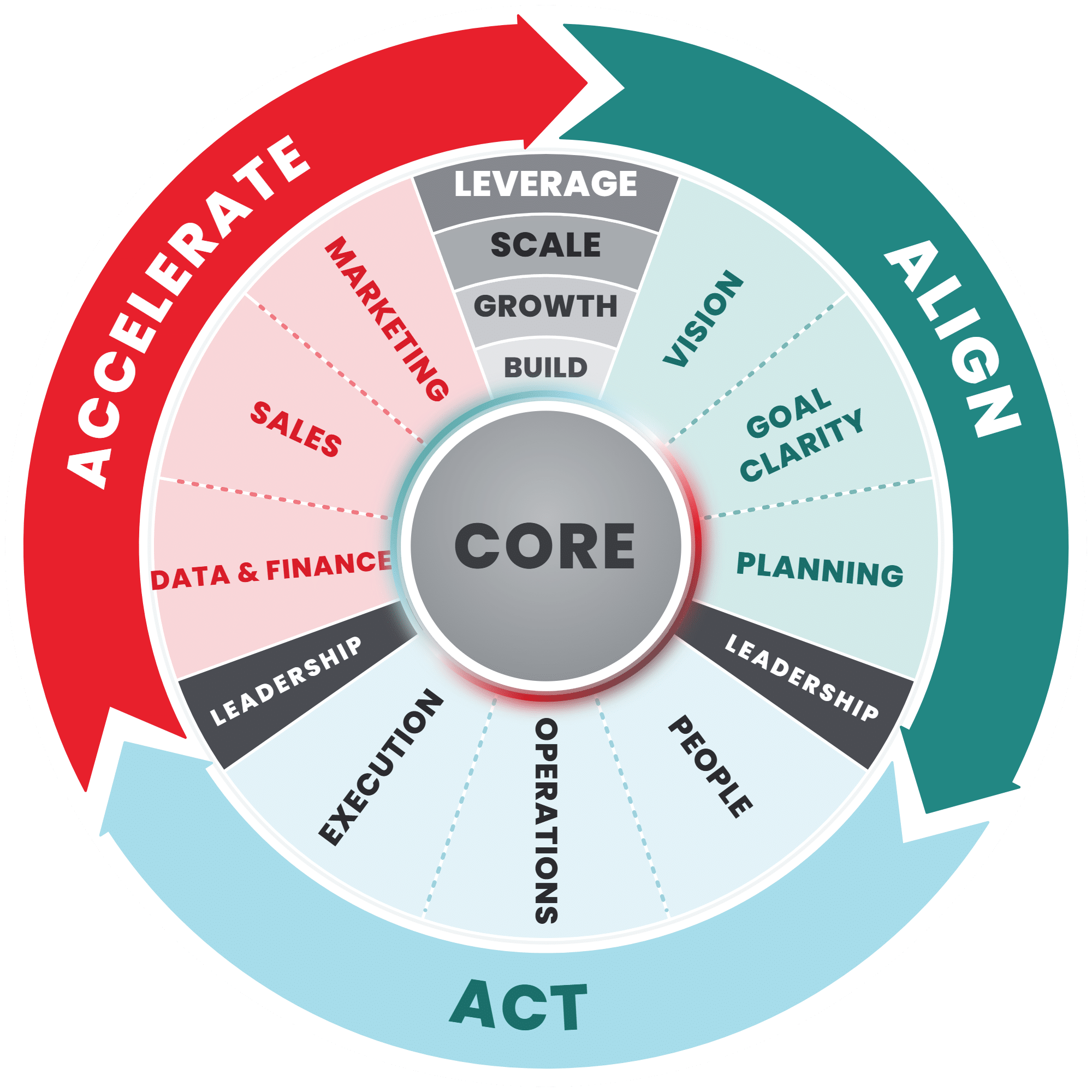
In the Align Operating System (AOS), created by Core Profit Builders (CPB) for residential cleaning companies, this work lives in the Align phase, which includes three pillars: Vision, Goal Clarity and Planning. Those pillars come first for a reason. When direction is unclear, every other pillar, from People to Marketing, pulls in a different direction. You can explore all nine pillars on the AOS pillars page.
Why goals fail without strategic goal setting
Goals rarely fail because they are too ambitious. They fail because nothing connects them to daily work. In a cleaning company, the day is consumed by operations: schedules shift, a client is unhappy, a cleaner calls out sick. Without structure, those urgent tasks always beat important ones.
The most common reasons goals fall apart are predictable:
- Too many goals. Ten priorities means no priorities. The team cannot tell what matters most.
- No owner. A goal that belongs to "everyone" belongs to nobody.
- No measure. "Improve quality" cannot be tracked. "Reduce re-cleans to fewer than two per week" can.
- No rhythm. Goals reviewed once a year are forgotten by February.
- No link to the vision. When the team does not understand why a goal matters, motivation fades quickly.
Strategic goal setting addresses each of these directly. It limits the number of priorities, assigns ownership, defines measures and builds a weekly review rhythm into the business.
The 4-step strategic goal setting cascade
CPB teaches strategic goal setting as a simple cascade: vision, then annual goals, then Quarterly Drivers, then weekly actions. Each level answers a different question, and each one depends on the level directly above.
Step 1: Clarify the vision
Your vision answers the question: what are we building, and why? It describes the company you want in several years, including the kind of clients you serve, the culture you want, the role you want to play as owner and the life the business should support.
A strong vision is specific enough to guide decisions, which is what makes strategic goal setting possible. If your vision includes stepping out of daily operations, then hiring an operations manager is clearly a priority. If it includes being known for exceptional service, then quality systems matter more than rapid expansion. Write it down in plain language, keep it to a page, and share it with your leadership team.
Step 2: Set three to five annual goals
Annual goals are the second layer of strategic goal setting. They translate the vision into this year's targets. Keep the list short. Three to five goals is enough for most companies, and fewer is often better. Each goal should be measurable and tied to the vision.
Good annual goals for a cleaning company might cover revenue and profit, team size and retention, client retention, or the owner's time. Avoid vague goals. "Hire better people" is a hope; "build a team of twelve cleaners with two trained team leaders" is a goal. The SBA guide to writing a business plan is a helpful outside reference for connecting goals to financial planning.
Step 3: Break goals into Quarterly Drivers
A year is too long to manage directly. Quarterly Drivers are the handful of priorities that will move your annual goals forward in the next 90 days. They are where strategic goal setting becomes practical, because 90 days is long enough to finish meaningful work and short enough to stay focused.
Each Quarterly Driver needs one owner, a clear definition of done and a due date at the end of the quarter. For example, if an annual goal is to reduce owner involvement in scheduling, a Quarterly Driver might be "document the scheduling process and train the office manager to run it." Our guide to quarterly priorities for a cleaning business walks through how to choose them.
Step 4: Break drivers into weekly actions
Weekly actions are the specific tasks people commit to completing this week. They are small, concrete and visible to the team. This is the level where most plans break down, and where strategic goal setting either works or quietly fails.
A weekly action might be "draft the first three steps of the scheduling SOP" or "post the job listing and screen five applicants." When these commitments are reviewed every week, progress compounds. When they are not, the quarter slips away.
A strategic goal setting example for a residential cleaning company
Here is a simplified, hypothetical example of how the cascade fits together. Your details will be different, but the structure stays the same.
- Vision: a respected residential cleaning company with a stable, well-trained team, where the owner leads strategy and no longer runs the daily schedule.
- Annual goal: move scheduling, quality checks and client communication to the office team by the end of the year.
- Quarterly Driver: document the scheduling process and train the office manager to run it, owned by the owner and due at the end of the quarter.
- Weekly actions: write the first draft of the scheduling SOP this week, have the office manager shadow scheduling next week, then let the office manager run Monday scheduling with the owner reviewing.
Notice how each level is smaller and more concrete than the one above it. That is the heart of strategic goal setting: a clear line from the life and company you want to the work someone will do on Tuesday. Our guide to cleaning SOPs shows how to document processes like this one, and how to stop being the bottleneck explains why handing off daily decisions matters so much.
The same structure works for any goal. A pricing goal might cascade into a Quarterly Driver to review every recurring client's rate, then weekly actions to analyze ten accounts at a time. A hiring goal might cascade into a Quarterly Driver to build a repeatable interview process. Strategic goal setting does not change the goal; it changes how reliably the goal gets done.
Tools that keep strategic goal setting alive all year
A plan only works if it stays in front of people. CPB uses a few simple tools to keep strategic goal setting part of the weekly routine instead of an annual event.
- GET (Growth Execution Tool): tracks KPIs, commitments and accountability so everyone can see progress on Quarterly Drivers and weekly actions.
- Weekly scorecard: five to ten numbers reviewed every week, so you can see whether your goals are on track. See our guide to cleaning business KPIs and the weekly scorecard.
- Weekly leadership meeting: a short, consistent meeting to review numbers, check commitments and solve problems. Our article on the weekly leadership meeting for a cleaning business includes an agenda.

The point of these tools is not paperwork. It is visibility. When goals, numbers and commitments are visible every week, small problems get solved while they are still small.
Common planning mistakes to avoid
Even owners who understand the cascade can stumble when strategic goal setting meets a busy season. Watch for these patterns:
- Planning alone. Strategic goal setting done by the owner in isolation gets less buy-in. Involve your leadership team in setting Quarterly Drivers.
- Skipping the vision. Jumping straight to revenue targets leaves the team without a reason to care.
- Overloading the quarter. Three to five Quarterly Drivers for the company is plenty. More usually means none get finished.
- Not adjusting. Strategic goal setting is not rigid. If something changes, update the plan at the next quarterly review rather than abandoning the whole process.
- Ignoring capacity. A goal to add many new clients without a plan to hire and train cleaners creates stress, not growth.
Leadership matters here too. Liz Trotter, CPB's founder, often coaches owners through GOOYOW (Get Out Of Your Own Way), because the biggest obstacle to a good plan is frequently the owner's habit of jumping back into daily work.
How coaching supports strategic goal setting
You can build this cascade on your own, and many owners start that way. What coaching adds to strategic goal setting is consistency. A plan that is reviewed with a coach and peers every week is far more likely to stay alive than one kept in a desk drawer.
CPB's Mastery Circle is built around this rhythm. Owners meet with Liz every Monday for a one-hour goal check-in, track progress in GET, and work through ALIGN, ACT and ACCELERATE with group feedback and hot seats, in groups of up to 15 owners. Mastery Circle supports all five AOS levels: Core, Build, Growth, Scale and Leverage. Each level builds on the last, with increasing capability across the same operating system.
For owners who want one-on-one help building their vision and annual goals, private coaching with Liz is available. CPB also runs live events where owners work on planning away from the daily noise. Liz has been a part owner in six cleaning companies, so she has lived the planning process she teaches.

For more free perspective, the SBA guide to managing your business and SCORE mentoring are both useful, and the Smart Business Moves podcast, co-hosted by Liz and Tom Stewart of MaidCentral, regularly covers planning and leadership for cleaning company owners.
Your first 30 days
- Week 1: Take the free AOS Diagnostic and look at your Vision, Goal Clarity and Planning scores. Write a one-page vision for your company.
- Week 2: Set three to five measurable annual goals that connect directly to your vision. Share them with your leadership team and ask for feedback.
- Week 3: Choose three to five Quarterly Drivers, assign one owner to each, and define what done looks like by the end of the quarter.
- Week 4: Start a weekly leadership meeting and scorecard. Review weekly actions every week and track commitments in one visible place.
Key takeaways
- Strategic goal setting connects a long-term vision to annual goals, Quarterly Drivers and weekly actions.
- Goals fail when there are too many, no clear owner, no measure, no rhythm or no link to the vision.
- Quarterly Drivers are where big goals become practical 90-day priorities with one owner each.
- Weekly actions, a scorecard and a weekly leadership meeting keep the plan alive all year.
- Coaching adds consistency and accountability, which is where most plans break down.
Next step: Take the free AOS Diagnostic to see your Vision, Goal Clarity and Planning scores, then contact our team to talk through your plan.
Watch & put it to work
Connect your vision with a measurable goal
Clarify the direction you want to pursue and examine the work behind one company goal. Free archive lessons from Liz Trotter.

Why Your Company Isn’t Meeting Its Goals
Liz asks what you measure: activities, core KPIs and the work that contributes to your company's goals.
Identifying Your Dream
Liz discusses identifying your dream and points viewers to Lessons for Success by Lorraine A. Darconte.
View all LIZ A.R.D.S. · Archive recordings may mention past events or offers.
Frequently asked questions
What is strategic goal setting?
Strategic goal setting is the practice of connecting a long-term vision to a few measurable annual goals, then breaking those goals into Quarterly Drivers and weekly actions with clear owners. It converts intentions into a plan the whole team can follow.
How many goals should a cleaning company set each year?
Three to five annual goals is enough for most cleaning companies. Each should be measurable and tied to your vision. Fewer, clearer goals usually lead to more progress than a long list.
What are Quarterly Drivers?
Quarterly Drivers are the handful of priorities that move your annual goals forward in the next 90 days. Each one has a single owner, a clear definition of done and a due date at the end of the quarter.
How often should we review our goals?
Review weekly actions and your scorecard every week, Quarterly Drivers every quarter, and annual goals and vision at least once a year. The weekly rhythm is what keeps a plan from being forgotten.
Where should I start if I have never done this before?
Start with the free AOS Diagnostic. It takes about ten minutes, asks 18 questions, and shows your AOS Score, current level and pillar scores, including Vision, Goal Clarity and Planning.
Turn these ideas into consistent action
Mastery Circle gives owners weekly goal check-ins with Liz, KPI review, group feedback and accountability.
Not sure where to focus? Take the optional AOS Diagnostic.

Founder of Core Profit Builders and creator of the Align Operating System (AOS). Part owner in six cleaning companies. Certified High-Performance Coach (CHPC) and co-host of the Smart Business Moves podcast.
More about Liz